domingo, 27 de marzo de 2016

BINATIONAL ART AUCTION April-22th-2016
SUBASTA DE ARTE BINACIONAL - 22 de Abril de 2016

Part of the revenue that will be obtain from the Art Auction to celebrate the next April 22th at the Brownsville Museum of Fine Art,  will go to Good Neighbor Settlement House Organization, which guards the reception of migrant children into the USA.

Parte de los ingresos que generará la Subasta de Arte del próximo 22 de Abril en el Museo de Bellas Artes de Brownsville, se destinará a la organización Good Neighbor Settlement House, que vela por los niños migrantes acogidos en Estados Unidos.


Five of the twenty five artists chosen, live in the Texan city.
Three original watercolors on Arches watercolor paper 300 gr/m2, presented at the Casamata Museum last year, will be auctioned.


De los veinticinco artistas seleccionados, cinco residen en la ciudad tejana
Tres acuarelas sobre papel Arches (300 gr/m2), presentadas en el Museo Casamata el año pasado, irán a dicha Subasta.


Man with chickens, Marrakesch. Watercolor on Arches paper. 15.2" x 11.2"
Hombre con gallinas, Marrakech. Acuarela sobre papel Arches. 38.5 x 28.5 cm.


Door, Matamoros. Watercolor on Arches paper. 15.2" x 11.2". Sold to private collector.
Puerta, Matamoros. Acuarela sobre papel Arches. 38.5 x 28.5 cm. Sold to private collector.


Yatch. Watercolor on Arches paper. 15.2" x 11.2"
Yate. Acuarela sobre papel Arches. 38.5 x 28.5 cm.


lunes, 22 de febrero de 2016

EUGÈNE BABOULÈNE - 'STILL LIFE WITH MELONS' LITOGRAPH - DONATION TO THE BROWNSVILLE HISTORICAL ASSOCIATION

Introduction/Introducción
Eugène Baboulène (1905-1994) born and dies in Toulon, a french city located between Marseille and Saint-Tropez. It belongs to the region called Provence-Alpes-Côte d'Azur. Baboulène studies at the School of Fine Arts (l'Ecole des Beaux-Arts) of Toulon (1917-1924). He is a student of Gabriel Amoretti, Edmond Barbaroux and Laurent Mattio.

Eugène Baboulène (1905-1994) nace y muere en Toulon, ciudad costera francesa localizada entre Marsella y Saint-Tropez, y perteneciente a la región de Provence-Alpes-Côte d'Azur. Baboulène estudia en la Escuela de Bellas Artes de su ciudad (1917-1924). Es alumno de Gabriel Amoretti, Edmond Barbaroux y Laurent Mattio.


MATTIO, Laurent. Le port de Marseille. Oil on panel. 21.26" x 25.59"
MATTIO, Laurent. El puerto de Marsella. Óleo sobre tabla. 54 x 65 cm

He travels to Paris, where he also studies at the National School of Decorative Arts (1929-1931). He also attends some courses at the National School of Fine Arts (l'Ecole Nationale des Beaux-Arts).

Viaja a París, siendo estudiante también en la Escuela Nacional Superior de Artes Decorativas (1929-1931). Además, asiste al mismo tiempo a algunos cursos en la Escuela Nacional Superior de Bellas Artes.

In 1931, the artist returns to Toulon, where he decorates, among other buildings, the Theatre of the city. Before the II World War, Toulon is an attractive city to artists searching light on their landscapes. In 1936, Baboulène a teacher at the School of Fine Arts of Toulon, meets with other artists that are also teachers at the University, such as the french impressionist landscape painter Jose Mange (1866-1935), and Henri Olive-Tamari (1898-1980).

En 1931, el artista vuelve a Toulon, y decora, entre otros edificios, el teatro del municipio. En los años previos a la II Guerra Mundial, Toulon es una ciudad atractiva para los pintores en busca de luz en sus paisajes. En 1936, Baboulene, profesor en la Escuela de Bellas Artes de su ciudad natal, coincide con otros artistas que imparten también clases, profesores como el pintor impresionista francés de paisajes José Mange (1866-1935) y Henri Olive-Tamari (1898-1980). 


MANGE, José. Vie form Le Fort du Cap Brun
MANGE, José. Vista desde Fort du Cap Brun

He has a first exhibition at the Salon des Indépendants in 1939, but after a decisive meeting with Antoni Clavé, an exiled catalan painter, painting will be his only dedication from 1945. From the fifties, his talent is recognized. In 1979, he becomes a l'Académie du Var member.

Tiene una primera exposición en el Salón des Indépendants en 1939, pero tras un encuentro decisivo con Antoni Clavé, pintor catalán exiliado, la pintura será su única dedicación a partir de 1945, siendo a partir de los años cincuenta cuando se reconoce su talento. En 1979 pasa a ser miembro de l'Académie du Var.

CLAVÉ, Antoni. Costumes for Carmen (1949). Engraving on Arches paper
CLAVÉ, Antoni. Vestidos para Carmen (1949). Grabado sobre papel Arches

Baboulène is considered one of the best painters of the Contemporary School School of Provence. His work is characterized by a warm and unpretentious atmosphere on his landscapes and seascapes, represented by bold but harmonic colors. His painting is considered the most reflexive within the figuration trend.

Baboulène está considerado como uno de los mejores pintores de la Escuela Contemporánea de la Provenza.  Su obra se caracteriza por la atmósfera cálida y sencilla de sus paisajes y marinas, representados mediante colores audaces y sin embargo, armónicos. Su pintura se considera la más reflexiva dentro de la figuración.

"Still Life with Melons" Lithography. Provenance/Litografía"Naturaleza con melones". Procedencia


BABOULÈNE, Eugène - "Still Life with Melons". Lithography (12 colors). 18.5" x 22.5"
BABOULÈNE, Eugène - "Naturaleza muerta con melones". Litografía (12 colores). 36,5 x 57 cm


The original provenance of the "Still Life with Melons" lithography is the Galerie Romanet, París. It consists on a design done with twelve on Holland Van Gelder paper. The full set is numbered from 1 to 35, and printed in the Master Printer Atelier called Ballon, Paris. 
The artist creates the harmony using a base of primary color, yellow. This color covers a considerable part of the paper; over the base said, Baboulène mixes another primary color, blue, to the different ranges of green: from warm (fruit), to semi-cold (edges of the pillow) or cold (gray green on wall of the background). Finally, by using of a color adjacent to the third primary (red), such as umber, the artist finishes the work, adding punctual strokes in black to shape other objects.

La litografía "Naturaleza muerta con melones", procede originalmente de la Galerie Romanet, París. Está compuesta por doce colores sobre papel holanda Van Gelder. La tirada está numerada del 1 al 35, e impresa en el Taller del Maestro Impresor Ballon, en París. El artista crea la armonía a partir de una base con un color primario, el amarillo. Este color cubre gran parte de la obra, sobre el cual Baboulène mezcla otro color primario, el azul, para formar diferentes matices cálidos de verde en la fruta, semifríos en los bordes del almohadón, o bien un verde grisáceo frío para alejar la pared del fondo. Finalmente, usa un color adyacente al tercer primario (rojo), el tierra, para rematar la obra mediante unos toques puntuales en negro que conforman otros objetos.


BABOULÈNE, Eugène - Numeration and quality of the paper
BABOULÈNE, Eugène - Numeración y calidad del papel

This print is the number 18/35, as it can be seen in the lower left corner. The artist also writes the kind of paper used, "Hollande".

Se trata del ejemplar número 18/35, como puede observarse en el margen izquierdo inferior de la obra, donde el artista ha indicado el tipo de papel, "Hollande".


BABOULÈNE, Eugène - Artistic signature
BABOULÈNE, Eugène - Firma artística

The artist's signature appears in the opposite margin (lower right corner)

La firma del artista figura en el margen contrario (margen inferior derecho).


BABOULÈNE, Eugène - Provenance & Artistic characteristics
BABOULÈNE, Eugène - Procedencia & características artísticas

The reference paper from the french galerie is a surprise, because the name of the work is "Still Life with Melons", so it could indicate that the set clearly focus towards the international market. As shown, there is another set done on Arches paper (numbered from 1 to 55).
The dimensions are 18.5" x 22.5".

The date could be something between 1974 and 1978, due the similarity with some oil paintings from that era.

Sorprende que el papel de referencia de la galería francesa titula la litografía como "Still life with melons", lo que podría indicar su orientación hacia el mercado internacional de esta serie.
Tal y como se indica, existe otra tirada de esta serie sobre papel Arches (numeradas del 1 al 55).
Las dimensiones de la litografía son de 46 x 57 cm.

Posiblemente Baboulène la cree entre 1974 y 1978, por su similitud con algunos óleos de esa época.

Last provenance: Estate of L.R. Baker, Harlingen, Tx (08/28th-29th/2015). Bought on the 29th.

Última procedencia: herencia de L.R. Baker, Harlingen, Tx (28-29/08/2015). Comprado el día 29.


Custom Framing/Enmarcado


BABOULÈNE, Eugène - Custom Framing Shop Seal
BABOULÈNE, Eugène - Sello de la tienda de enmarcado

The lithography is framed in "Prints, etc." 
The store is located in 494 Jackson Square, San Francisco, California. Its opening was in 1957, and it is still open. The shop also sells antique prints, old photos from San Francisco, etc. Possibly this lithograph was bought in the same shop in the late 70's, considering the previous comment concerning the title of the work. It has been protected by a matted (ivory color) and glass.

La litografía está enmarcada en "Prints, etc".
La tienda se encuentra en 494 Jackson Square, San Francisco, California. Su inauguración fue en 1957, y hoy en día todavía sigue operativa. Vende además grabados antiguos, fotos antiguas de San Francisco, etc. Posiblemente esta litografía fue adquirida en la propia tienda hacia finales de los años 70, considerando el comentario del título de la obra antes realizado. Se protege mediante un paspartú de color marfil y un cristal.

Awards/Premios
1950: Prix Ève
1952: Prix Othon Frièsz
1955: Prix Esso
1956: Grand Premier Prix du Festival d'Avignon - Avignon, France
1957: Grand Premier Prix de la Biennale de Menton - Menton, France

Solo Exhibitions/Exposiciones individuales
Galerie Romanet, París (1958)
Chateau Gaillard, Les Andelys (1959)


Galerie Romanet, París (1962)


Galerie Romanet, París (1965)

Galería Tamenaga, París (1974)
Musée Paul Valéry, Séte. Rètrospective (1981)
Le Chateau de Val, Lanobre (1983)
Galerie Arpé, Cannes (1983)
Hôtel de Ville, La Seyne-sur-Mer (1986)


Galerie 26, París (1990)


Galerie 26, París (1991)

Group Exhibitions/Exposiciones colectivas
Salon des Indépendants, París (1939)
Le Salon d'Automne, París (1950)
Salon des Tuileries, París (1952)
Tooth Gallery, Londres (1954)
Peintres Témoins de leur Temps, París (1954-1976)
Niza (1958 y 1960)
Salon des Tuileries, París (1961)
Tooth Gallery, Londres (1961)

Fine Art Museums/Museos de Bellas Artes - Rouen, Nantes y Grenoble (1961)

Other cities/Otras ciudades - Béziers, Angers, Estrasburgo, La Haya, Burdeos, Lyon, Mulhouse, Génova, Canadá, La Rochelle, Valence, Lausanne, Mälmo (1953 - 1963), Orán, Nueva York, Palm Beach, Narbonne, Osaka, Villeneuve-sur-Lot, Nevers, Montauban, Gênes, Marsella, Rennes, Saint-Tropez, Berlín, Tokio, Madrid, Dallas and/y Abidjan.

Colections/Collecciones
Museums/Museos
Museums of Marseille, Toulon, Avignon, Toulouse, Rodez, Montauban, Baux de Provence and Orange

Others/Otros
University Fairleigh Dickinson, Rutherford (New Jersey)
Wilmington (Ohio)
Colgate University
Hamilton (New York)
Law School of Theuviver, City of Pennsylvania
National Art Foundation, Champaign (Illinois)
Glassboard Teacher's College (New Jersey)
Eastern College (Montana)
Rutgers University (New Brunsurch)
Oklahoma Art Center (Oklahoma City)
Lehigh University, Bethelem, Pennsylvania
Lincoln University (Pennsylvania)

Bibliography/Bibliografía
NACENTA, Raymond (1960). School of Paris: The Painters and the Artistic Climate of Paris Since 1910. Greenwich, Connecticut: New Graphic Society

YAGIL, Limore (2015). Au nom de l'art (1933-1945). Exils, solidarités et engagements. Paris: Librairie Arthiènne Fayard.

"Obituary: Eugene Baboulene", Independent, Sunday July 18th 1994.
Recuperated on 2016-02-21
http://www.independent.co.uk/news/people/obituary-eugene-baboulene-1416112.html

"Eugene Baboulene, French (1905-1994)", ROGallery.com
Recuperated on 2016-02-21
http://rogallery.com/Baboulene_Eugene/baboulene-biography.html

sábado, 19 de diciembre de 2015

FOOL FOR LOVE (SAM SHEPARD) & ELVIS PRESLEY FOREVER (USPS)

"Locos de amor" (1983), escrita por Sam Shepard, fue editada en España en 1998 por Anagrama. Es una obra de teatro donde los personajes encadenan encuentros y desencuentros mediante ásperos diálogos, motivados por un amor incontrolado por los celos mutuos. ¿Cómo dar Lo Real, ese imposible que diría Lacan, que ha sido expulsado por Lo Simbólico de la realidad? Al no poder ser simbolizado en la palabra, la única manera de traerlo de nuevo a Lo Simbólico es por contraste, esto es, a través del trauma: Eddie y May se aman, sí, o no, o no se sabe bien hasta que avanza la lectura: su relación arde porque subyace el incesto. Un tabú demasiado fuerte, dramático en la sociedad.


"Es un absoluto infierno", diría Shepard refiriéndose al enamoramiento que tuvo por Jessica Lange, tras compartir protagonismo en la durísima película "Frances" (1982), de Graeme Clifford. Probablemente ese mismo sentimiento le ayudaría a escribir la obra, ya que en 1983 comenzaron a vivir juntos como pareja.

MARTIN (en la ventana, mirando las llamas)
¿Es tuyo el camión que hay ahí fuera, con el remolque para caballos?

EDDIE (sigue con May)
Sí.

MARTIN
Está ardiendo.

EDDIE
Sí.

MARTIN
Los caballos se han escapado.

"Fool for Love" (1983), written by Sam Shepard, was published in Spain in 1998 by Anagrama. It's a play where the characters link meetings and disagreements through harsh dialogues, motivated by uncontrolled love or mutual jealousy. How to obtain the Real, that impossible as Lacan said, which has been expelled by the Symbolic of the reality? Unable to be symbolized with the word, the only way to bring it back to the Symbolic, that is, by contrast, through the trauma: Eddie and May are in love, yes, or not, or we do not really know until you advance the reading: their relationship burn because underlies an incest. Too strong taboo, dramatic in our community.


Borromean Knot and the 4 elements linked.
The four registers of subjectivity

"It is an absolute hell," would said Shepard referring to his amorousness on Jessica Lange, after sharing the main characters of the tough film 'Frances' (1982), directed by Graeme Clifford
Probably the same feeling would help him to write this book, considering that in 1983 they began to live as a couple.

MARTIN. (Upstage out window, looking out into the flames). Is that your truck, with the horse trailer out there?

EDDIE. (Stays with May). Yeah.

MARTIN. It's on fire.

EDDIE. Yeah.

MARTIN. All the horses are loose.

El significante llega violentamente, pues violento es el amor en juego. Y ahora se da inscrito en el orden de lo simbólico: el camión arde. Estamos ante el "mal encuentro" experimentado por el sujeto, según el accidente citado por Freud y retomado como ejemplo por Lacan: un padre sueña que su hijo, muerto en la realidad a consecuencia de una fiebre, le interpela.
- ¡Padre!, ¿no ves que ardo?
El padre no despierta, mientras en la otra habitación arde el cadáver del niño al haberse caído una vela del velatorio.
El camión representa la permanente huida de la que le acusa May. Ahora que está en llamas, que ya es inservible, la huida se representa mediante los caballos.

EDDIE (se aleja de May)
Si, me lo figuraba.

MAY
Eddie...

EDDIE
Voy a salir a echar un vistazo. Por lo menos tengo que echar un vistazo, ¿no?

The significant comes violently, because violent is the love at stake. And now occurs inscribed within the order of the symbolic: the truck burns. We are facing the "bad encounter", experienced by the subject, according to the accident aforementioned by Freud, and taken up by Lacan as an example: a father dreams that his son, really dead as a result of a fever, challenges him.
"Father !, don't you see that I'm burning?"
The father did not wake up, while in the other room the child's body burns because a candle in the wake has fallen.
The truck represents the permanent escape accused by May. No that it is on fire, that is already useless, the flight is represented by the horses. 

EDDIE. (Steps back away from May). Yeah, I figured.

MAY. Eddie-

EDDIE. (To May). I'm just gonna' go out and take a look. I gotta' at least take a look, don't I?

Eddie no va a comprobar el estado de su propiedad, no le hace falta, dice. Sólo pretende huir una vez más.
El propio Shepard acostumbraba a hacerlo en su vida real: cogía su coche y escapaba al sur, sin más motivo que el conducir. Sin destino alguno. Lo recoge en alguno de sus cuentos.
Y May, que se da cuenta, hace la maleta y se va tras Eddie. Y es que no se puede vivir ni con el objeto de deseo 'a' explicado por Lacan, ni sin él. Ese amor entre los protagonistas, es el sinvivir. El viejo, con la afirmación categórica final, no hace más que confirmar lo contrario y corroborar lo Real, el imposible.

VIEJO (señalando el espacio vacío, a la izquierda)
¿Ves ese cuadro de ahí? ¿Lo ves? ¿Sabes quién es? Esa es la mujer de mis sueños. Es ella. Y es mía. Toda mía. Para siempre.

Eddie does not check how are his properties, he does not need it, he said. Eddie is going to run away, once more. 
Shepard himself used to do it in his real life: he took his car quite often, and escape to the south, for no other reason that driven. Without any destination. In many of his stories is written.
And May, that realizes it, pack up and goes after Eddie. Because you can not live with the object-cause of desire 'a' explained by Lacan, or without it. That love between the protagonists, is a desperation. With the final categorical statement, the Old man does nothing but confirm the opposite, and corroborate the Real, the impossible.

THE OLD MAN. (Pointing into space). Ya' see that picture over there? Ya' see that? Ya' know who that is? That's the woman of my dreams. That's who that is. And she's mine. She's all mine.

Debido a la obsesión del escritor por Lange, Sam incumplió su compromiso con Wim Wenders, no actuando ni concluyendo el guión de "Paris-Texas" (1984), si bien éste se encontraba prácticamente perfilado. Bastaron unas cuantas -desesperadas- llamadas del director al dramaturgo, para que Wenders pudiera retomar y finalizar la historia.
La portada de ese libro, "Locos de amor", siempre me ha cautivado: una fotografía en la cual Alfred Wertheimer atrapa a un Elvis Presley jugando, sin disimulo, con el principio de un beso. El cosquilleo del espectador contemplando esta foto, tal vez se deba a la directa y aislada sensación que puede provocar la parte más carnal del beso, desnudo en sí. La cita se produce entre bastidores del Teatro Mosque, en Richmond, Virginia. El concierto ya ha terminado. Y Elvis aún no era famoso.

Because of the writer's obsession for Lange, Sam failed to fulfill his commitment with Wim Wenders, without acting or completing the screenplay for "Paris-Texas" (1984), although this was practically outlined. It took a few -hopeless- calls from the director to the playwright, in order that Wenders could return and finish the story.
The cover of the book, "Fool for Love" has always intrigued me: a photograph in which Alfred Wertheimer catches Elvis Presley, openly playing, with the beginning of a kiss. The tickling of the viewer contemplating this photograph, it might be due to the direct and isolated thrill that could cause the most carnal part of a kiss, itself naked. The date occurs in the backstage of the Mosque Theater in Richmond, Virginia. The concert is over. And Elvis was not famous yet.

Alfred Wertheimer. Entre bastidores. Teatro Mosque, Richmond, Virginia. 30 de junio de 1956
Alfred Wertheimer. Backstage. Mosque Theatre, Richmond, VA. 30th. June, 1956

Unos meses antes, el 12 de marzo, Weltheimer había recibido una llamada: Anne Fulchino le pedía cubrir el Show de los Hermanos Dorsey, Tommy y Jimmy. "Fotografía sólo a Elvis", dijo. "¿Elvis quién?", preguntó él. Aquella sesión sería el principio de un vínculo del que no se ha podido separar jamás. La eternidad por esas fotografías hechas durante una serie de años a un cantante que pasó de ser desconocido a un ídolo mundial. Pero Alfred aún no lo sabía.

A few months earlier, on March 12, Wertheimer had received a call: Anne Fulchino asked him to serve the Dorsey Brothers Show, Tommy and Jimmy. "Only shoot to Elvis Presley," she said. "Elvis who?," he asked. That work would be the beginning of a link which he has not been able to ever separate from it. The eternity fo those photographs done during a number of years to a singer who went from being unknown to a world idol. But Alfred did not know yet.

Alfred Wertheimer. Show en Directo de los Hermanos Dorsey. 17 de Marzo de 1956
Alfred Wertheimer. The Dorsey Brothers Stage Show. 17th March 1956

No era la primera vez que Elvis se dejaba retratar. Entre finales de 1954 y principios de 1955, ante la insistencia de su promotor, Bob Neal, William Speer le haría once fotos de desigual calidad. A Elvis le gustaron, como también a Neal, pues entre 1955 y 1958 Speer haría fotos de otro de sus músicos, Johnny Cash. Presley se acercó de nuevo para que el fotógrafo retratara a su novia. Comenzó a cantar en el cuarto de espera, pero Speer le mandó callar. Nunca volvió. William acababa de perder a quien pudo ser su mejor cliente, pero en ese momento, todavía lo ignoraba.

It was not the first time that Elvis let himself to be photographed. Between late 1954 and early 1955, due the insistence of his music representant, Bob Neal, William Speer would make eleven photos of uneven quality. Elvis liked them, such as Neal, because between 1955 and 1958 Speer photographed to other of his musicians, Johnny Cash. Presley came back so the photographer could photograph his girlfriend. He began to sing in the waiting room, but Speer order him to stop. He never returned. William lost paradise, but at that time, he ignored yet.

William Speer. Elvis con cazadora deportiva blanca y camisa marrón. Hacia 1954-1955
William Speer. Elvis wearing a maroon shirt and a hite sport coat. Over 1954-1955

Sesenta años más tarde, el Servicio Postal de Estados Unidos (USPS) ha publicado una magnífica serie dentro de la colección Iconos, simulando la envoltura de un disco de vinilo. Para ello rescata la "mejor fotografía hecha nunca de Elvis", según críticos de arte y musicales, y la imprime dieciséis veces. En la otra cara, Elvis se encuentra en plena actuación. Adivinen quien tiene un juego.

Sixty years later, the United States Postal Service (USPS) has published an excellent series within the Icons collection, simulating the covers of a vinyl record. The USPS rescues the "best picture ever made of Elvis," according to art critics and music, and prints it sixteen times. On the flip side, Elvis is performing. Guess who has a full sheet.


USPS. Elvis Presley Forever. Colección del autor
USPS. Elvis Presley Forever. Personal Collection


lunes, 21 de septiembre de 2015

FESTIVAL INTERNACIONAL TAMAULIPAS 2015 - JUAN M. VELEZ - Exposición

DECLARACIÓN - STATEMENT

“La íntima conciencia que tenemos -decía el filósofo José Gaos, español exiliado durante la Guerra Civil española y pronto nacionalizado mejicano en 1941-, es la percepción interna”; con ella percibimos nuestras imaginaciones, pensamientos o sentimientos, pero no de los objetos. De los objetos, como de lo imaginado, nos quedamos únicamente con la percepción externa. En la percepción lo percibido está presente, mientras que un objeto o un sentimiento ajeno nos están representados. Por ello, tanto imágenes como recuerdos, pensamientos y la mayoría de los sentimientos, no tienen naturaleza de actos. Actos serían las percepciones, o los propios actos de imaginar, recordar y pensar, o el propio acto de amar u odiar. Imaginamos cosas puramente imaginarias, como la imagen de un centauro. "La imagen de un centauro es el equivalente del caballo percibido. No es el equivalente del acto de la percepción. Lo equivalente del acto de la percepción con que percibimos el caballo, es el acto de la imaginación con que nos imaginamos la imagen del centauro". Por tanto las imágenes no son actos, sino objetos de actos. 
Y como tales objetos, puede proponerse su representación. Si hay conformidad entre la proposición y la realidad percibida, la propuesta será verdad, y falsa si ocurre lo contrario. De ese modo, que el artista proponga objetos no terminados en los que los espectadores no pierdan la percepción de tales objetos, sería verdad. En estos trabajos, continuación de los expuestos recientemente en el Museo Fuerte Casamata de esta misma ciudad y que aún pueden visitarse, son la forma más próxima a los objetos que percibo, y una forma de representarme a través del agua y del color.
La propuesta no persigue la exactitud en su representación, sino que el espectador, a través de su acto de imaginar, los complete conforme a su imaginario. Si el espectador lo recuerda, y lo percibe equivalente, la propuesta será verdad.
Así, cabría que la propuesta apenas contuviera unos rasgos suficientemente distintivos de la Catedral para que el matamorense la percibiera como válida, permitiéndole la libertad para cerrar el dibujo. Podría sugerirse por presencia de color, como en “Edificio Telefónica desde Bellas Artes” o su ausencia, “Catedral de nuestra Señora del Refugio”; o por línea a lápiz/color, como “Gran Vía desde Bellas Artes”, y cómo no, por ambas, “Casa de Correos. Reloj de Torre, Madrid”.
Se han trabajado varias técnicas: en acuarela, seco sobre seco (evitando la transparencia habitual del medio), húmedo sobre seco, y húmedo sobre húmedo, mientras que en tinta aguada seco y aplicando agua a continuación.
La muestra se centra prácticamente en el paisaje urbano de Matamoros y Madrid.


‘The inner consciousness that we have- said the philosopher José Gaos, spaniard exiled during the Spanish Civil War and soon nationalized mexican in 1941)-, is the internal perception’; with it, we perceive our imaginations, thoughts or feelings, but not the objects. From objects, as from what we imagined, we take only the external perception. In perception is being present what we perceived, while an object or an alien feeling are represented. Therefore, both images and memories, thoughts and feelings do not have nature of acts. Perceptions would be acts, or imagining acts themselves, or remembering and thinking, or the act of love and hate itself. We imagine purely imaginary things, like the image of a centaur. 'The image of a centaur is the equivalent of the horse perceived. It is not the equivalent of the act of perception. The equivalent of the act of perception we perceive the horse, is the act of imagination that we imagine the image of a centaur'. Images, memories, thoughts or most of feelings are not acts, but intentional objects. Therefore 'the images are not acts[...]but objects of acts'.
And as such objects, representation may be proposed. If there is an agreement between the proposition and the perceived reality, the proposal will be true, and false if the opposite happens. Thus, if the artist proposed unfinished objects in which viewers do not lose the perception of such objects, the proposed representation would be true. In these works suchs as those hanging right now at Casamata Museum, are the closest way to the objects I perceive, and a way to represent me through the water and color.
The proposal does not pursue the accuracy of its representation, but that the viewer, through his act of imagining, could complete the objects in accordance to their imagination. If the viewer remembers and perceives equivalency, the proposal will become true.
The proposal, for example, could contain some sufficiently distinctive features of the Cathedral, so the matamorense perceived it as meaningful, allowing to the viewer sometimes the freedom to close the drawing. It might be suggested by color, as in ‘Telefonica Building from the Fine Arts Building’, or its lack such as in ‘Virgen del Refugio Cathedral’; or with line/color as ‘Gran Via from Fine Arts Building’, and of course, using both of them, such as in ‘Casa de Correos, Watch Tower’.
Several techniques have been used: dry on dry (avoiding the usual transparency of the watercolor), wet in dry and wet in wet.

The exhibition almost focuses in urban landscape of Matamoros and Madrid.


Gran Vía con Alcalá, Madrid. Acuarela sobre papel. 28,6 x 38,0 cm
Gran Via & Alcala Street. Watercolor on paper. 11.0" x 15.0"


Monasterio de las Descalzas, Madrid. Acuarela sobre papel. 26,0 x 23,2 cm

Monastery of las Descalzas, Madrid. Watercolor on paper. 10.2" x 9.0" 


Edificio Telefónica desde Bellas Artes, Madrid. Acuarela sobre papel. 28,5 x 38,3 cm

Telefónica Building from Fine Arts, Madrid. Watercolor on paper. 11.0” x 15.0”


Plaza de Castilla, Madrid. Acuarela sobre papel. 28,5 x 38,3 cm. Vendida a coleccionista privado.

Plaza de Castilla, Madrid. Watercolor on paper. 11.0”x 15.0”. Sold to private collector.


Gran Vía desde Bellas Artes, Madrid. Acuarela sobre papel. 38,0 x 28,5 cm
Gran Vía from Fine Arts, Madrid. Watercolor on paper. 15.0” x 11.2”


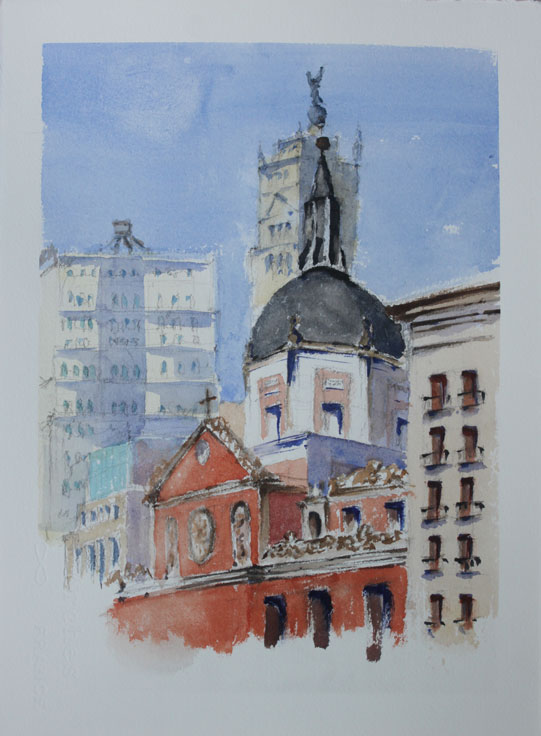
Iglesia de las Calatravas, Madrid. Acuarela sobre papel. 38,5 x 28,5 cm. Vendida a coleccionista privado
Church of Las Calatravas, Madrid. Watercolor on paper. 15.2” x 11.2”. Sold to private collector


Casa de Correos. Reloj de Torre, Madrid. Acuarela sobre papel. 37,5 x 28,2 cm

Correos House. Tower’s Clock, Madrid. Watercolor on paper. 14.8” x 11.1”


Catedral de Nuestra Señora del Refugio. Acuarela sobre papel. 28,5 x 38,0 cm. Vendida a coleccionista privado
Nuestra Señora del Refugio’s Cathedral. Watercolor on paper. 11.2” x 15.0”. Sold to private collector


Plaza de Armas. Kiosko, Matamoros. Acuarela sobre papel. 28,5 x 38,0 cm. Vendida a coleccionista privado.

Armas Square. Kiosk, Matamoros. Watercolor on paper. 11.2” x 15.0”. Sold to private's collector.


Presidencia Municipal, Matamoros. Acuarela sobre papel. 28,5 x 38,0 cm
Municipal Palace, Matamoros. Watercolor on paper. 11.2” x 15.0”


Casa Cross, Matamoros. Acuarela sobre papel. 38,0 x 28,5 cm. Vendida a coleccionista privado

Cross House, Matamoros. Watercolor on paper. 15.0” x 11.2”. Sold to private collector


Restaurante El Paraíso, Matamoros. Acuarela sobre papel. 38,0 x 28,5 cm
El Paraíso Restaurant, Matamoros. Watercolor on paper. 15.0” x 11.2”


Puerta, Matamoros. Acuarela sobre papel. 31,0 x 22,9 cm
Door, Matamoros. Watercolor on paper. 12.2” x 9.0”


Casamata. Carreta, Matamoros. Tinta aguada sobre papel. 14,0 x 21,6 cm

Casamata. Cart, Matamoros. Watered ink on paper. 5.5” x 8.5”


Hibisco blanco, Matamoros. Acuarela sobre papel. 15,6 x 22,9 cm

White hibiscus, Matamoros. Watercolor on paper. 6.1”x 9.0”


Autobús urbano, Matamoros. Tinta aguada sobre papel. 14,0 x 21,6 cm
Urban bus, Matamoros. Watered ink on paper. 5.5” x 8.5”


Estación Southern Pacific, Brownsville. Tinta aguada sobre papel. 21,6 x 14,0 cm. Vendida a coleccionista privado
Southern Pacific Station, Brownsville. Watered ink on paper. 8.5” x 5.5”. Sold to private collector


Puerta de Alcalá, Madrid. Acuarela sobre papel. 23,0 x 31,0 cm
Alcalá Gate, Madrid. Watercolor on paper. 9.0” x 12.2”


Quijote. Tinta aguada sobre papel. 21,6 x 14,0 cm
Quixote. Watered ink.  8.5” x 5.5”


Iglesia de las Calatravas, Madrid. Acuarela sobre papel. 31,0 x 23,0 cm
Church of Las Calatravas, Madrid. Watercolor on paper. 12.2” x 9.0”


Puerta de Toledo violeta, fondo Biblioteca, Madrid. Tinta aguada y pastel sobre papel. 30,0 x 15,0 cm. Colección del autor
Toledo Gate violet, Public Library background, Madrid. Watered ink and pastel on paper. 11.8” x 5.9”. Author's collection


Puerta de Alcalá violeta, fondo Retiro, Madrid. Tinta aguada y pastel sobre papel. 15.0 x 30.0 cm. Colección privada

Alcala Gate violet, Retiro’s Park background, Madrid. Watered ink and pastel on paper. 5.9” x 11.8”
Private collection